
Cutting and construction
How to label cut quilt pieces so the pile still makes sense tomorrow
The first few cuts are easy to remember. After an evening of strip sets, background squares, and nearly identical triangles, a label is kinder than memory.
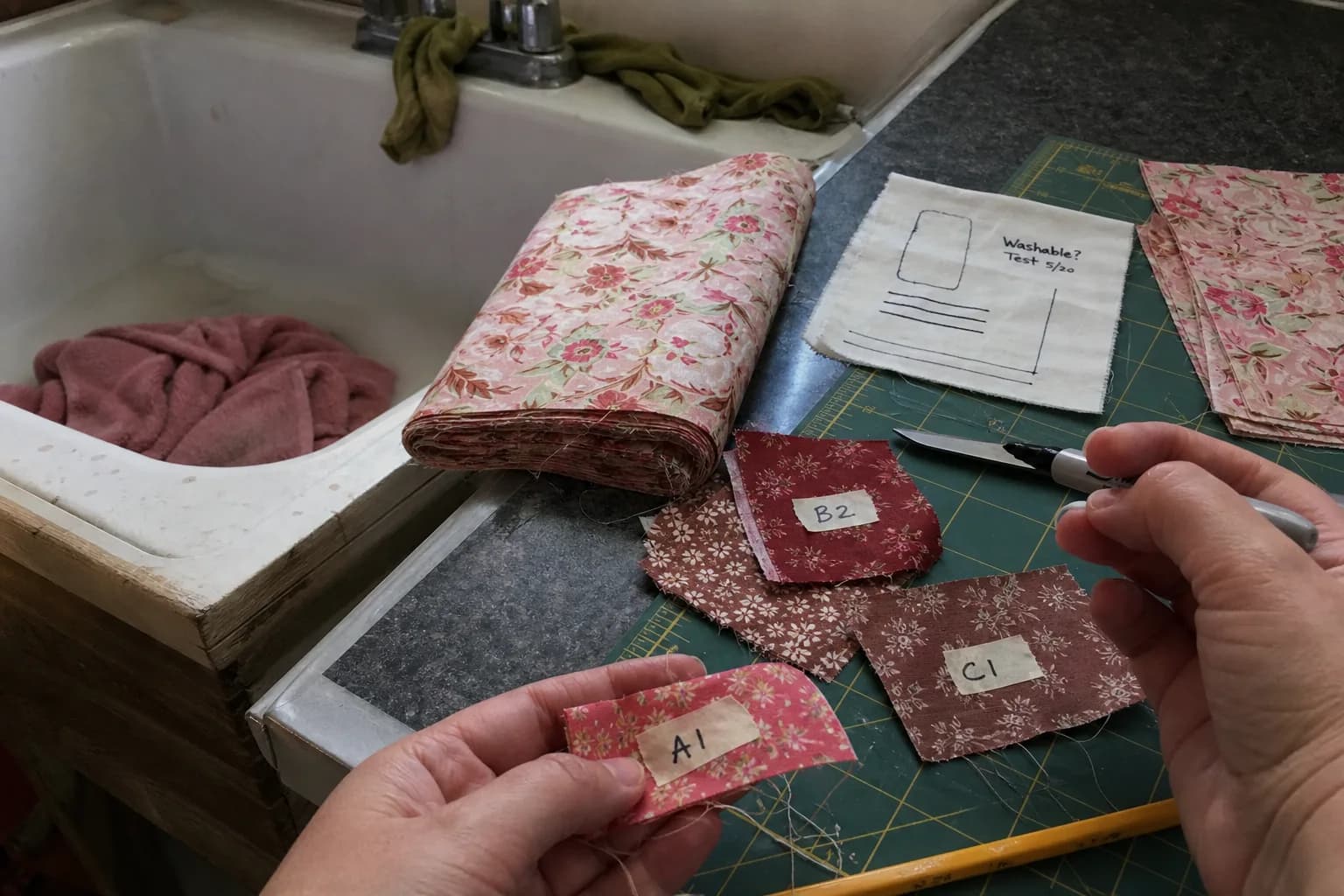
At the cutting table
What to notice first
- What information a label needs
- Ways to label without damaging fabric
- How to keep repeated units together
- A cutting-table routine
A label protects the information that disappears after cutting
Fabric is easy to identify when it is a folded half-yard beside its label. It is less obvious when it becomes forty 2½-inch squares, eight rectangles, and a stack of mirrored triangles. A label keeps the connection between the piece, the pattern role, and the next sewing step.
This matters most for repeated blocks, fabric substitutions, directional prints, and patterns that use lettered or numbered units. You are not making paperwork for its own sake. You are keeping yourself from sewing the correct-size piece into the wrong place because every scrap looked familiar at 10 p.m.
Use the pattern's own names first
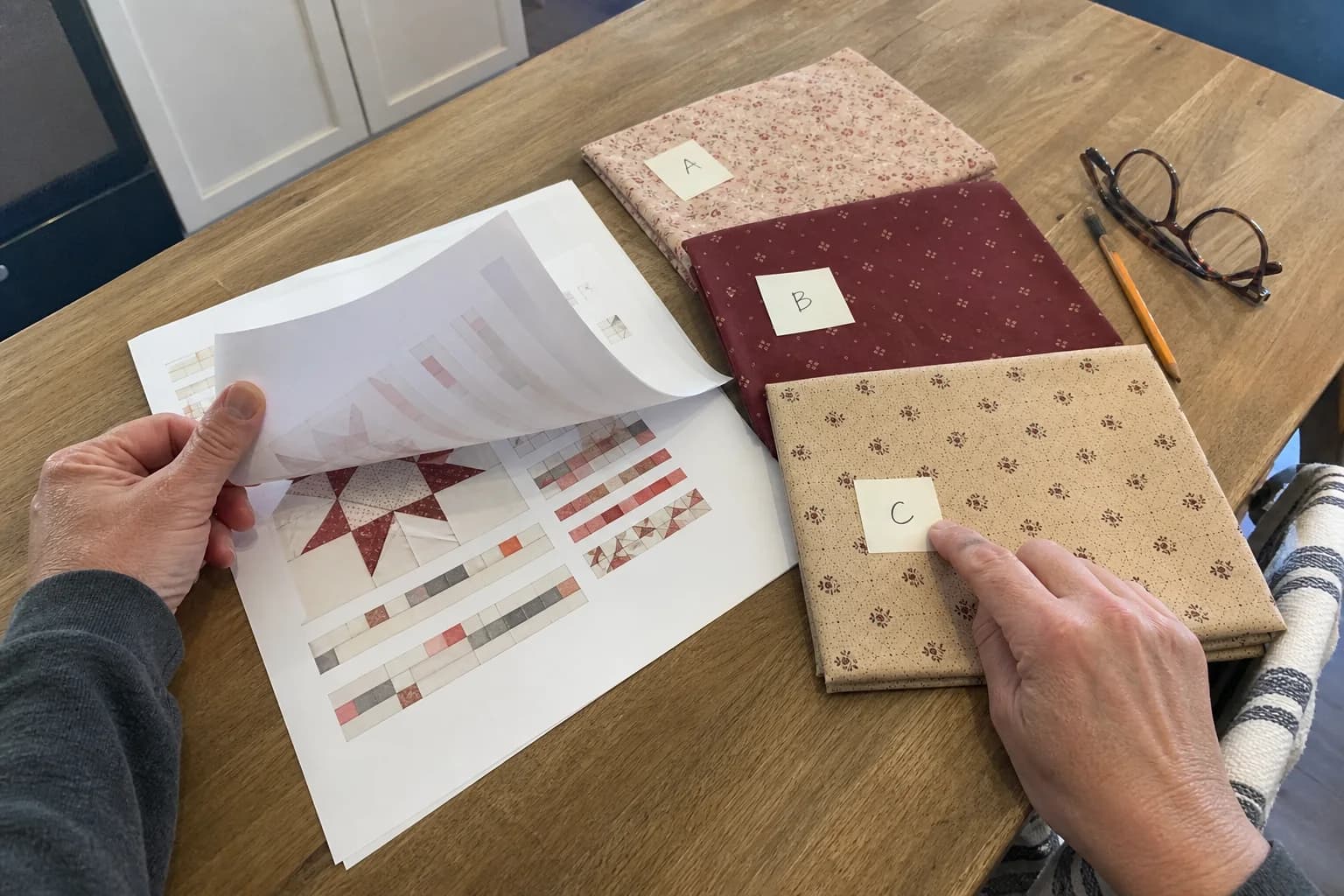
Before cutting, copy the pattern's fabric key and unit labels onto a project note. If the pattern says Fabric A is background and Unit B is cut from Fabric C, use those names. Inventing a second naming system can create a translation problem halfway through assembly.
Add only what the pattern does not make obvious: your substitute fabric name, the block number, a count, or an orientation note. “C, 16, tree tops up” is more useful than “green triangles.” It tells you what the stack is, how many should be there, and what design decision must survive the sewing machine.
Worktable routine: label the stack, not every piece
- Cut one pattern unit at a time, rather than building a giant mixed pile.
- Put its pieces in a small tray, envelope, bag, clip, or stack with a paper label.
- Write the pattern unit, fabric role, quantity, and any orientation note.
- Check the count against the cut list before moving to the next unit.
- Keep the label with the units until that step is sewn and confirmed.
For example, a star quilt might have a stack labeled “Unit B: 24 background squares, 24 navy triangles, make 12 flying geese.” A second stack could read “Unit C: 8 center squares, roses upright.” The labels are compact, but they preserve the instructions you need when you return after dinner or a few days away.
Give directional fabric an arrow
For directional fabric, add a clear arrow or words such as “top toward border” to the paper label. Lay out one completed or paper block before chain piecing to confirm you have interpreted that direction correctly. If a pattern intentionally rotates blocks, label the block position too: upper left, upper right, and so on.
A note is not permission to alter a pattern's construction. If the source does not show a measurement, method, or placement clearly, stop and check with the designer. A pretty diagram can help you plan, but it does not safely supply missing cutting directions.
Keep labels low-tech and removable
Painter's tape on a container, a folded paper slip under a clip, index cards, and zip bags can all work. Choose something that does not leave residue on fabric or get lost in a scrap basket. If you mark fabric, test the marking method on a scrap and follow the product guidance. You do not need a permanent ink mark to remember that a triangle belongs in row three.
At the end of a session, put the current block, its labeled units, and the pattern page together. That small reset makes the next session much less likely to begin with detective work.
Labels make pressing and assembly calmer too
Once units are sewn, keep block rows in order with the same system. A labeled row can be pressed, checked, and returned to its place without guessing which side is up. See pressing versus ironing quilt blocks for a careful next step, then use the quarter-inch seam check if units are not finishing at the expected size.
The questions that come up next
Common questions
Should I write directly on quilt fabric?
Use a marking method only where it is appropriate for the fabric and project. Many quilters keep identifying notes on clips, paper tags, containers, or the pattern instead.
How do I label triangles that all look alike?
Keep a small labeled stack or tray for each unit and include the pattern label, quantity, and orientation if it matters.
Do I need labels for a simple quilt?
Maybe not many. Labels earn their keep when pieces are similar, construction spans more than one session, or direction and placement matter.
Quilt math, without the second-guessing
One short email when a new guide or calculator lands. No sales sequence.
You're agreeing to quilt-math emails from Stitchtale. Unsubscribe any time; this is separate from signing in.