
Quilt planning
Quilt size chart: single, double, queen and king measurements
A bed label is useful shorthand, but it is not a finished-quilt measurement. Start with the mattress in front of you, decide where you want the quilt to end, and turn those choices into a size you can use for blocks, borders, backing, and batting.
Plan backing for your chosen size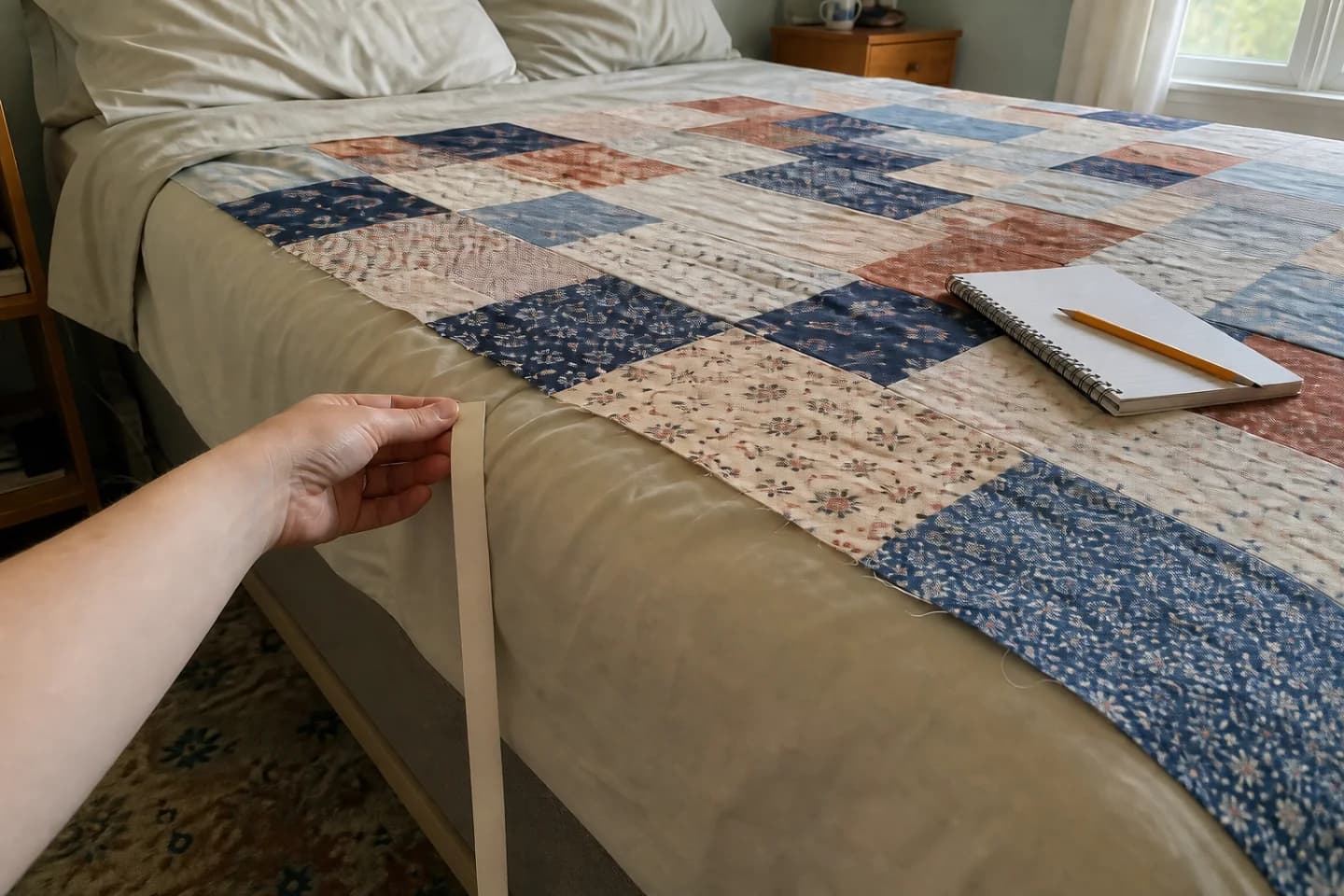
At the cutting table
What to notice first
- How single, twin, double, and full labels relate
- Common mattress and quilt starting sizes
- How to calculate the drop you want
- What to check before buying fabric
Bed quilt measurements at a glance
If you need a number to start planning, use about 68 × 88 inches for a single or twin, 81 × 96 inches for a double or full, 90 × 102 inches for a queen, or 108 × 102 inches for a king. These are finished-quilt starting points. The mattress depth, side drop, pillow coverage, and bed frame decide whether they fit the bed in front of you.
Single and twin usually mean the same starting point
In the United States and Canada, single and twin often describe a mattress around 38 by 75 inches. Double and full often describe a mattress around 54 by 75 inches. The names can change across countries, manufacturers, XL sizes, and older beds, so use the printed dimensions when a pattern, mattress, or bed comes from somewhere else.
That naming check matters before fabric is bought. A search for a double-bed quilt may lead to a chart written for a different market. If the dimensions are missing, measure the bed instead of trying to settle the label.
Common bed and quilt sizes in inches and centimetres
The table below is a planning reference for quilts that cover the mattress and hang over the sides. The mattress measurements are common North American references, not guarantees. The quilt measurements are useful starting points, not rules.
| Bed label | Common mattress reference | Quilt starting size |
|---|---|---|
| Single / Twin | 38 × 75 in 97 × 191 cm | about 68 × 88 in 173 × 224 cm |
| Double / Full | 54 × 75 in 137 × 191 cm | about 81 × 96 in 206 × 244 cm |
| Queen | 60 × 80 in 152 × 203 cm | about 90 × 102 in 229 × 259 cm |
| King | 76 × 80 in 193 × 203 cm | about 108 × 102 in 274 × 259 cm |
Put a tape measure across your own mattress before choosing one of these quilt sizes. A deep mattress, topper, platform frame, pillow tuck, or generous side drop can make a sensible finished size quite different from the chart.
Calculate the quilt from the mattress and drop
For a simple over-the-bed quilt, start with the mattress width and add the planned drop on both sides. Start the length with the mattress length, then add the drop at the foot and any coverage you want at the head.
- Finished quilt width: mattress width + left drop + right drop.
- Finished quilt length: mattress length + foot drop + head or pillow coverage.
This formula describes the quilt you want to see on the bed. It is not a cutting instruction and it does not add backing or batting overhang.
Worked example: a queen mattress with a 12-inch drop
Suppose the mattress measures 60 by 80 inches. You want 12 inches of drop on both sides, 12 inches at the foot, and no extra length over the pillows. The planned finished quilt is 84 by 92 inches.
- Width
- 60 + 12 + 12 = 84 inches.
- Length
- 80 + 12 = 92 inches.
- Planned finished quilt
- 84 × 92 inches (about 213 × 234 cm).
That result is smaller than the queen starting size in the table because this example does not cover the pillows and uses a specific 12-inch drop. The difference is the point: the chart begins the conversation, while the bed and your preference finish it.
Try the proposed edge on the actual bed
Before building a large layout around one number, mark the proposed edge with a sheet, painter's tape, safety pins, or the quilt top if it already exists. Stand back from the bed and look at the side and foot coverage. Check whether the frame, box spring, or storage underneath will show.
Stop before buying all the fabric if the mattress has not been measured, the bed label and dimensions disagree, or you have not decided what happens at the pillows. Those are size decisions, not problems to solve later with extra borders.
Let the block layout respond to the finished size
Once you have a target, work backward into blocks, sashing, and borders. A layout may land a little smaller or larger than the first number. Borders can help, but calculate their order and finished spans instead of adding a width by eye. Read the border guide before committing fabric.
Move from bed size into material planning
The finished quilt-top size becomes the input for backing, batting, and binding. Backing and batting need extra fabric beyond the top. Binding uses the final perimeter after borders, quilting, and trimming. Use the backing calculator and batting calculator only after the finished top size is settled.
Bed-quilt planning checklist
- Measure mattress width, length, and depth, including a topper.
- Confirm whether single/twin or double/full is only a naming difference.
- Choose the side, foot, and head coverage you want.
- Test the proposed edge on the actual bed.
- Translate the finished size into blocks, sashing, and borders.
- Calculate backing, batting, and binding from that finished size.
The questions that come up next
Common questions
What size quilt fits a single or twin bed?
A common starting point is about 68 by 88 inches (173 by 224 cm), but measure the mattress and choose the side and foot drop before treating that as your finished size.
What size quilt fits a double or full bed?
A common starting point is about 81 by 96 inches (206 by 244 cm). Mattress depth, pillow coverage, and the amount of side drop you prefer can all change that number.
Is there one standard queen or king quilt size?
No. Queen and king labels describe the bed, not the exact quilt you want. Measure the mattress, including any topper, then add the side, foot, and head coverage deliberately.
When should I calculate backing and batting?
After you choose the finished quilt-top size. Backing and batting need their own extra allowance, so do not use the mattress label as the material measurement.
Quilt math, without the second-guessing
One short email when a new guide or calculator lands. No sales sequence.
You're agreeing to quilt-math emails from Stitchtale. Unsubscribe any time; this is separate from signing in.