
Try it in your colours
Tap a colourway, or pick each fabric. The film at the top changes too.
Quilts made with the Flying Geese
Watch it come togetherTwo Kinds of StarBaby quilt · 45″ square · Intermediate · 4 colourwaysMake this quilt
Watch it come togetherCranberry CandlelightTwin quilt · 67⅞″ × 84⅞″ · Confident beginnerMake this quilt
Watch it come togetherStars and Bow TiesBaby quilt · 48″ square · IntermediateMake this quilt
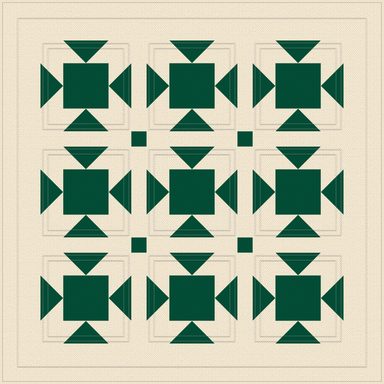 Watch it come togetherEvergreen StarsWall quilt · 38″ square · Confident beginner · 7 colourwaysMake this quilt
Cut sizes for one Flying Geese block
Pick the finished size. Every cut includes the ¼″ seam allowance.
| Piece | Cut | Qty |
|---|---|---|
| Flying-geese pointmain fabric | 3½″ × 2″ | 8 |
| Flying-geese sky squarebackground fabric | 2″ × 2″ | 16 |
| Piece | Cut | Qty |
|---|---|---|
| Flying-geese pointmain fabric | 5″ × 2¾″ | 8 |
| Flying-geese sky squarebackground fabric | 2¾″ × 2¾″ | 16 |
| Piece | Cut | Qty |
|---|---|---|
| Flying-geese pointmain fabric | 6½″ × 3½″ | 8 |
| Flying-geese sky squarebackground fabric | 3½″ × 3½″ | 16 |
Good to know
What size should I make a Flying Geese block?
Any size that suits your quilt. 12″ is the easiest to sew, and 9″ or 6″ look lovely in a busy, scrappy quilt. It sits on a 4 by 4 grid, so a finished size that divides by 4 gives you friendly cutting numbers. The cut sizes for all three are on this page.
How many Flying Geese blocks do I need for a quilt?
At 12″ you need 9 blocks for a wall quilt, 12 for a baby quilt, 30 for a throw, 48 for a twin quilt and 72 for a queen quilt. Sashing or a border between them means fewer blocks for the same size.
Is the Flying Geese good for a beginner?
Yes, if you take it slowly. The one new skill is the flying geese, and the film at the top shows every cut, seam and press.
What's the trick to a neat Flying Geese?
Sew a thread's width to the corner side of the drawn line. The fold eats that thread and your goose tip stays sharp.
Coffee and a few seams?
Start a quilt with the Flying Geese and we’ll walk you through every cut and seam.
Sew a Flying Geese quilt