
Technique choice
Appliqué vs. foundation paper piecing: which method fits your design?
The best technique is the one that lets the important shapes survive the trip from idea to quilt. FPP and appliqué solve different construction problems.
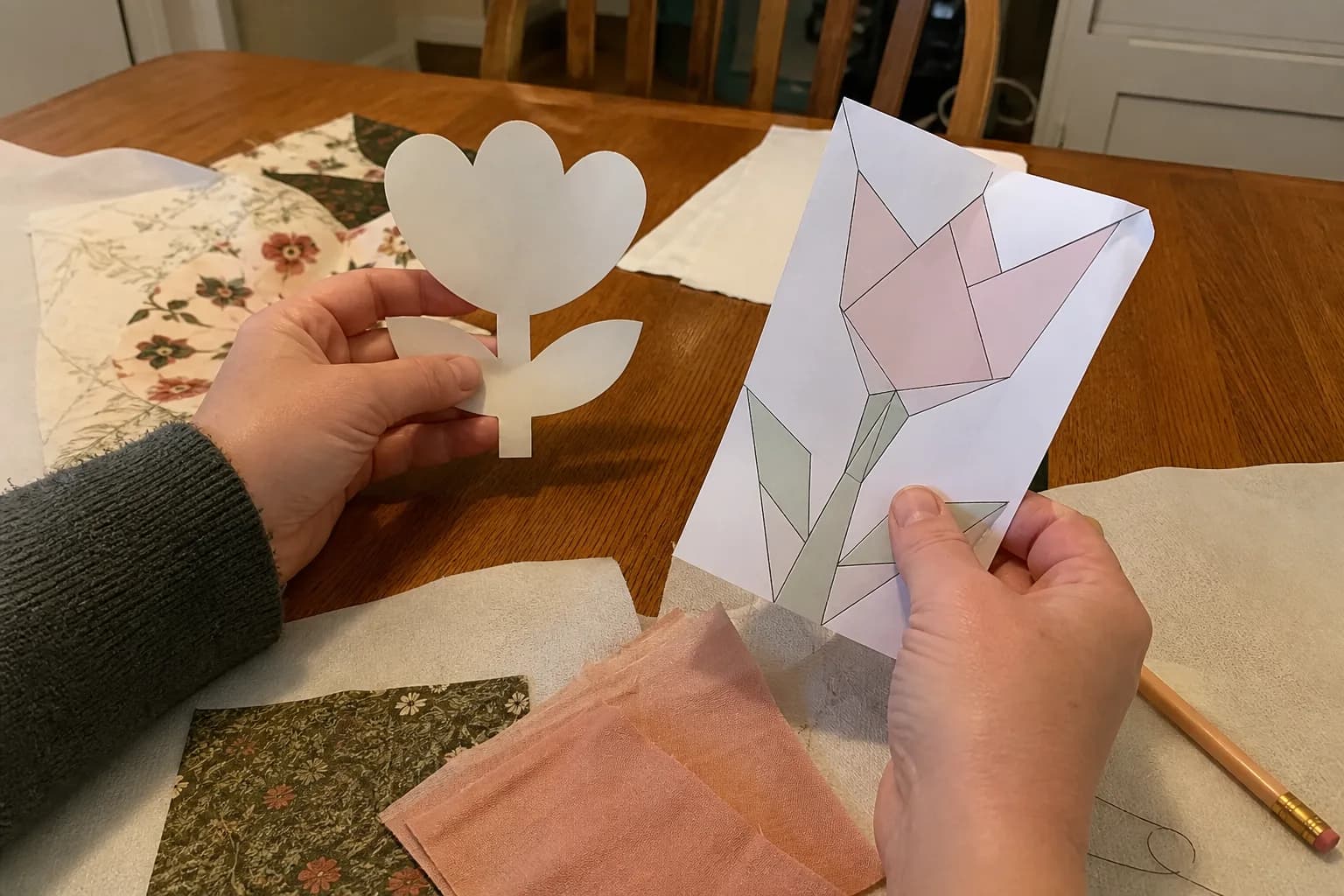
Start with the shapes you want to keep
Foundation paper piecing is built from straight construction seams. It is excellent at crisp points, sharp wedges, narrow geometric angles, letters, and sections that need to land at exact sizes. Appliqué layers one shape over another, which makes it a natural home for curves, organic silhouettes, enclosed shapes, and details that would become a forest of tiny seams if forced into FPP.
Neither method is a lesser version of the other. A flower with a soft curved petal can look more like itself in appliqué. A starburst with dozens of precise points may be more comfortable to make as FPP. Ask what the design needs to remain recognizable, then ask which construction method can carry that need honestly.
What FPP needs from a design
An FPP foundation needs more than angled color areas. Each section needs a workable sew-and-flip order, straight sewing lines, numbered patches, a trim boundary, seam allowance, a scale check, and a way to join the finished sections. The order must be physically possible: each new piece has to attach on a line and flip to cover its intended area without trapping an earlier piece or creating an unusable sliver.
That is why an angular picture is not automatically FPP-ready. It may be an excellent design reference, but until it has the required sewing information it is not a complete foundation pattern. A picture or editable layout can help you inspect the idea, but it does not supply numbered foundations and usable sewing instructions by itself.
What appliqué asks you to decide
Appliqué begins with shapes and placement. You choose or follow a method for preparing edges, such as turned-edge, raw-edge with stitching, fusible, needle-turn, or another approach specified by the pattern. The pattern should show the templates or finished shapes, placement order, overlap where needed, and how the edges are secured. Curves do not disappear as a challenge, but they remain curves rather than being translated into many straight seams.
Appliqué can also protect visual hierarchy. A face profile, animal silhouette, leaf, or lettering may need a smooth outline more than it needs patchwork detail. A simple pieced background plus a few well-placed appliqué shapes can be clearer and more enjoyable than an overcomplicated foundation.
A method-choice table
- Repeated straight units and sharp points: explore conventional piecing or compatible FPP.
- Full-size straight sections with a clear numbered order: FPP may be a good fit.
- Curves, organic outlines, and enclosed silhouettes: explore appliqué.
- An unclear source image or incomplete instructions: keep it as a planning reference until the construction method is resolved.
Use a small test for a big decision
Make one small section before committing. For FPP, print at actual size, measure the test square, and sew a foundation section through its outer trim. For appliqué, prepare one representative curve and try the chosen edge finish on the intended background. Look at the result from sewing distance and across the room. Does the point remain sharp? Does the curve still read as the shape you care about? Is the method pleasant enough that you want to repeat it?
A test does not turn an incomplete idea into a full pattern, but it gives you evidence about the method in your hands. Keep notes about needle, thread, stabilizer, and pressing so that a successful sample can be repeated.
Choose the claim as carefully as the method
It is fair to say a design is being explored as FPP or that a subject appears better suited to appliqué. It is not fair to call a picture “ready to make” until its named technique has the complete information it requires. For Stitchtale, compatible geometric FPP can be described in terms of actual-size foundations, numbered order, labels, trim guidance, and an assembly map when those parts are present and checked. Pictorial photo-to-FPP is still being tested and is not ready to cut from yet.
Next, read when a quilt image is not a pattern or revisit the FPP basics before choosing your first test.
The questions that come up next
Common questions
Is appliqué easier than FPP?
They ask for different skills. FPP rewards careful order and trimming for straight seams; appliqué asks you to prepare, place, and finish shape edges. Choose by the design and the finishing method you enjoy learning.
Can I turn an appliqué design into FPP?
Not simply by redrawing its outline with angles. A usable FPP version needs a legal numbered sew-and-flip plan, manageable sections, trim lines, and joining instructions. Some curved subjects are better kept as appliqué.
Can one quilt use both methods?
Yes. A quilt can use pieced or FPP backgrounds with appliqué focal shapes. The pattern should make the boundary between methods clear and give instructions for each.
Keep the project moving