
Quilt math
How much backing do I need for a quilt?
Backing starts with the finished quilt top, then adds room around every edge. The amount to buy depends on that larger rectangle, the usable width of your fabric, and how you choose to piece it.
Calculate your backing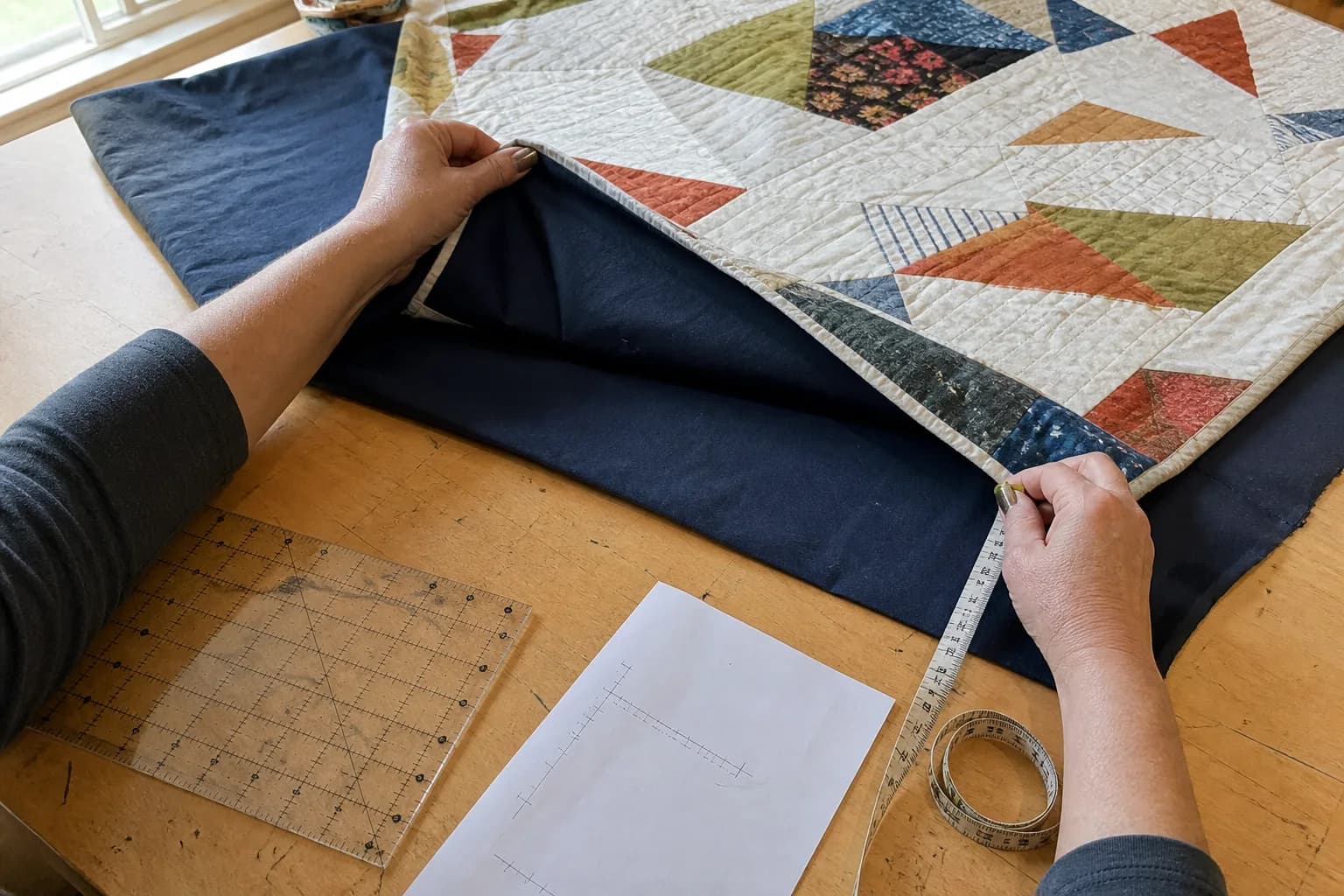
At the cutting table
What to notice first
- Why backing needs extra room
- How usable fabric width changes the plan
- When one width is enough
- How to check a pieced-backing example
Start with room around the finished top
Backing needs extra fabric beyond the finished quilt top so there is room to work while the quilt is being quilted. That extra amount is often called overhang. It is added on the left, right, top, and bottom, so the backing rectangle grows in both directions.
Choose the overhang for your project instead of treating one number as a rule for every quilt. If you are sending the quilt to a longarmer, ask what they require before you buy fabric or trim a backing panel.
Use the fabric width you actually have
Fabric width is part of the calculation, not a detail to fill in later. Use the usable width of the fabric after allowing for anything you will not use at the edges. A backing rectangle that fits one width of a wider fabric may need seams when made from a narrower fabric.
If one usable fabric width covers the needed backing rectangle, you can plan a single panel. If it does not, the backing must be pieced from two or more panels. The useful question is not whether seams are good or bad. It is whether the rectangle, fabric width, and panel direction are clear before you cut.
Check both panel directions before you cut
Panels can run the full backing height and sit side by side, or run the full backing width and stack from top to bottom. Those choices can produce a different number of panels, seams, and total yardage. When the panel count is tied, the amount of fabric can still differ.
There is no universal best seam direction. A directional print, the look you want on the back, and your quilting plan may matter as much as the arithmetic. Mark the intended top of a directional backing before piecing so you can confirm the print is facing the way you expect.
Worked example
A worked example with visible assumptions
Suppose a finished quilt top measures 60 by 80 inches. For this example only, use 4 inches of overhang on every side and 42 inches of usable fabric width. The backing rectangle becomes 68 by 88 inches.
- One 42-inch width cannot cover the 68-inch backing width, so a single panel is not enough.
- Two panels running the full 88-inch height cover the width. That is two 88-inch lengths, one seam, and 176 inches total, or 5 yards when rounded up.
- Three panels running the full 68-inch width cover the height. That is two seams and 204 inches total, or 5¾ yards when rounded up.
With those assumptions, the first plan uses fewer panels and less fabric. Change the overhang or usable width and the answer can change too. Use the quilt backing calculator to see the working for your own measurements.
Pause before purchasing
Write down the finished top size, your chosen overhang, usable fabric width, and the panel direction you intend to use. That gives you a plan you can check at the cutting table. It is an estimate for your stated inputs, not a substitute for a longarmer's requirements or the choices you make for a particular quilt.
The questions that come up next
Common questions
How much larger should backing be than a quilt top?
There is not one universal amount. Add the overhang required for your project on all four sides, and check a longarmer's requirements when someone else will quilt it. The calculator makes its chosen overhang visible so you can decide whether it fits your project.
Will I need to piece my quilt backing?
You will need more than one panel when the backing rectangle is wider than the usable fabric width in the direction you plan to use. Enter the usable width, rather than assuming every fabric has the same width, and check the panel plan before cutting.
Does the seam direction matter for pieced backing?
It can. Turning the panel plan can change the number of panels and the total fabric used. If the fabric has a direction you want to preserve, check how that direction will run across the finished backing before choosing a seam plan.
Keep the project moving
Read next
Quilt math, without the second-guessing
One short email when a new guide or calculator lands. No sales sequence.
You're agreeing to quilt-math emails from Stitchtale. Unsubscribe any time; this is separate from signing in.